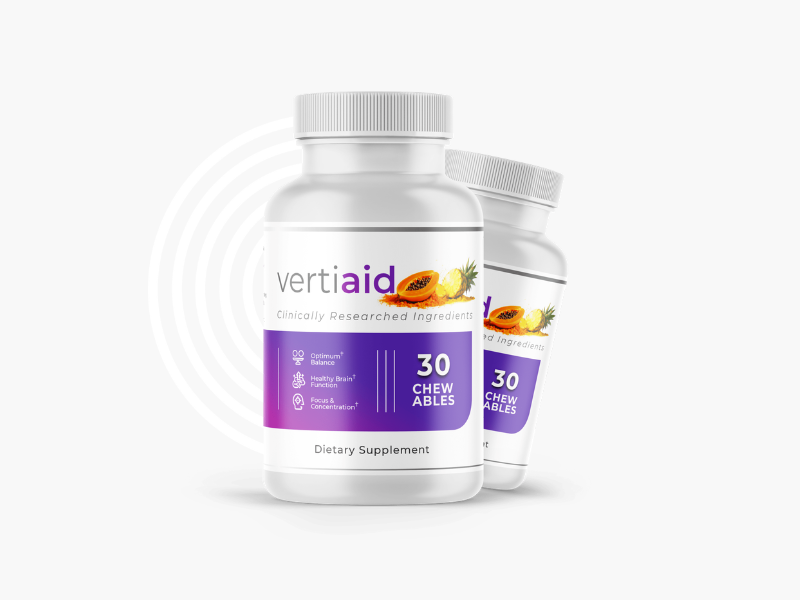
🔍 Quick Answer: VertiAid is a vertigo and balance support chewable rated 4.0/5 by BioBoost. It delivers 6 vitamins and minerals at disclosed doses (Vitamin D3 20 mcg, Riboflavin B2 1.3 mg, Vitamin B6 1.7 mg, Calcium from Aquamin® Sea Minerals 20 mg, Zinc-L-Carnosine 5 mg, Potassium 30 mg) plus a 227 mg proprietary blend of Papaya, Pineapple, Marine Collagen, Eggshell Membrane Collagen, and American Ginseng. The formula targets vestibular health through nutritional support rather than pharmaceutical intervention. Best for: adults experiencing occasional dizziness or balance concerns who want nutritional support alongside their healthcare provider’s guidance.
📋 Quick Verdict — VertiAid
Rating: ⭐⭐⭐⭐ 4.0/5 | Best for: Nutritional support for vestibular health and balance; adults with occasional dizziness
Strongest combo: Vitamin D3 (BPPV correlation) + Zinc-L-Carnosine (vestibular neuroprotection) + Riboflavin B2 (vestibular migraine) + American Ginseng (cognitive clarity) | Guarantee: 60-day money-back
▶ Watch the Official Video Presentation
VertiAid Review 2026: Our Evidence-Based Analysis
VertiAid approaches vertigo and balance support through a nutritional lens — providing vitamins, minerals, and botanical compounds that have varying degrees of connection to vestibular function, inner ear health, and balance-related neurological pathways. The formula combines conventional nutritional supplementation (B vitamins, Vitamin D3) with more novel ingredients (Zinc-L-Carnosine, Aquamin® calcium, dual collagen sources). Our Evidence Gap Analysis™ evaluates whether each ingredient has meaningful clinical support for the vertigo and balance claims on the label.
What Is VertiAid?
VertiAid is a chewable dietary supplement (30 chewables per bottle, 1 daily) formulated to support vestibular health and balance:
- Format: Chewable tablet (chew until dissolved or swallow with 6–8 oz water)
- Serving size: 1 chewable daily
- Active formula: 6 vitamins/minerals at disclosed doses + 227 mg proprietary blend (5 ingredients)
- Pricing: $69 (1 bottle) / $59 each (3 bottles) / $49 each (6 bottles)
- Guarantee: 60-day money-back, no questions asked
- Manufactured: USA, GMP-certified, FDA-registered facility
How Does VertiAid Work?
Pathway 1 — Vestibular Nutritional Foundation: Vitamin D3 deficiency has been consistently correlated with BPPV (Benign Paroxysmal Positional Vertigo) in multiple clinical studies. Vitamin D plays a role in calcium metabolism within the inner ear’s otoconia — the tiny calcium carbonate crystals whose displacement causes BPPV episodes. Riboflavin (B2) at therapeutic doses has been studied for vestibular migraine prevention.
Pathway 2 — Neuroprotective Mineral Support: Zinc-L-Carnosine is a chelated zinc form with documented neuroprotective and anti-inflammatory properties. Zinc deficiency has been associated with vestibular dysfunction in some clinical observations. Potassium supports proper nerve signal transmission essential for vestibular processing.
Pathway 3 — Structural & Connective Tissue Support: Marine Collagen and Avian Eggshell Membrane Collagen provide structural proteins that may support the connective tissues of the inner ear and vestibular apparatus. Aquamin® calcium from red marine algae offers a highly bioavailable mineral matrix.
Pathway 4 — Cognitive Clarity & Adaptogenic Support: American Ginseng (Panax quinquefolius) has documented effects on cognitive function, mental clarity, and stress adaptation — relevant since vertigo often co-occurs with brain fog, anxiety, and difficulty concentrating.
The Full Ingredient List
Vitamin D3 (Cholecalciferol) — 20 mcg (100% DV)
The strongest evidence-based ingredient in VertiAid for vertigo specifically. Multiple clinical studies have demonstrated a significant correlation between Vitamin D deficiency and recurrent BPPV. A landmark 2020 RCT (Jeong et al.) showed that Vitamin D3 + calcium supplementation significantly reduced BPPV recurrence rates. The 20 mcg (800 IU) dose is within the range used in vestibular studies, though some protocols use higher doses (1,000–2,000 IU). The active form cholecalciferol ensures good bioavailability.
📊 Evidence Gap Score: 7/10 ✅
Riboflavin B2 (Riboflavin 5’-Phosphate) — 1.3 mg (100% DV)
Riboflavin has been studied for migraine prevention, including vestibular migraine — a condition where vertigo episodes are associated with migraine pathology. The active form (riboflavin 5’-phosphate) ensures direct bioavailability. However, the clinical dose used in migraine prevention studies (Schoenen et al., 1998) was 400 mg/day — significantly higher than the 1.3 mg provided here at 100% DV. At this dose, riboflavin serves as a nutritional baseline rather than a therapeutic intervention.
📊 Evidence Gap Score: 4/10 ✅
Vitamin B6 (Pyridoxal 5’-Phosphate) — 1.7 mg (100% DV)
Vitamin B6 in its active form (P5P) supports neurotransmitter synthesis (serotonin, GABA, dopamine) and has well-documented anti-nausea properties — pyridoxine is an established treatment for pregnancy-related nausea. For vertigo, B6 may help manage the nausea component that frequently accompanies dizziness episodes. The 1.7 mg dose provides nutritional adequacy but is below therapeutic anti-nausea doses (10–25 mg).
📊 Evidence Gap Score: 4/10 ✅
Calcium (Aquamin® F Sea Minerals) — 20 mg (2% DV)
Aquamin® is a branded calcium derived from red marine algae (Lithothamnion) that provides a natural multi-mineral matrix with over 70 trace minerals. Calcium metabolism is directly relevant to BPPV — the otoconia in the inner ear are calcium carbonate crystals. The Jeong 2020 RCT used calcium alongside Vitamin D3 for BPPV prevention. However, the 20 mg dose (2% DV) is far below the 500 mg used in that study. The Aquamin form is a premium choice but the dose is primarily symbolic at this level.
📊 Evidence Gap Score: 3/10 ⚠️
Zinc (Zinc-L-Carnosine) — 5 mg (45% DV)
Zinc-L-Carnosine is a chelated form originally developed in Japan (Polaprezinc) with documented gastroprotective and anti-inflammatory properties. Its relevance to vestibular health is through zinc’s role in neuronal function and some clinical observations linking zinc deficiency to vestibular dysfunction and tinnitus. The chelated L-carnosine form also has neuroprotective properties, providing antioxidant protection to neural tissues including the vestibulocochlear nerve. At 5 mg (45% DV), the dose provides meaningful zinc nutrition.
📊 Evidence Gap Score: 4/10 ✅
Potassium (Potassium Bicarbonate) — 30 mg (1% DV)
Potassium is essential for nerve signal transmission and fluid balance — both relevant to vestibular function. The endolymphatic fluid in the inner ear requires precise electrolyte balance for proper vestibular signaling. However, at 30 mg (1% DV), this dose is nutritionally insignificant — the daily adequate intake is 2,600–3,400 mg. This ingredient serves more as a formula completeness element than a meaningful vestibular intervention.
📊 Evidence Gap Score: 2/10 ⚠️
Proprietary Blend — 227 mg (5 ingredients)
Papaya Powder: Contains papain enzyme with anti-inflammatory and digestive properties. May help with nausea management associated with vertigo. Pineapple Powder (Ananas comosus): Source of bromelain with anti-inflammatory and anti-edema activity. Some relevance to inner ear inflammation. Marine Collagen: Type I collagen supporting connective tissue integrity. Inner ear structures contain collagenous matrices. Avian Eggshell Membrane Collagen: Contains collagen, hyaluronic acid, glucosamine, and chondroitin. Supports joint and connective tissue health. American Ginseng Root Powder: The most relevant blend ingredient for VertiAid’s cognitive claims. Clinical studies demonstrate improvements in cognitive function, working memory, and mental fatigue. May address the brain fog and concentration difficulties that often accompany chronic vertigo.
📊 Evidence Gap Score (blend average): 3/10 ⚠️
Evidence Gap Analysis™ Summary
| Ingredient | Dose | Vestibular Relevance | Transparency | Score |
|---|---|---|---|---|
| Vitamin D3 | 20 mcg (100%) | BPPV correlation RCT; strongest evidence | ✅ Disclosed | 7/10 ✅ |
| Riboflavin B2 | 1.3 mg (100%) | Vestibular migraine (but 300x below study dose) | ✅ Disclosed | 4/10 ✅ |
| Vitamin B6 | 1.7 mg (100%) | Anti-nausea (below therapeutic dose) | ✅ Disclosed | 4/10 ✅ |
| Calcium (Aquamin®) | 20 mg (2%) | BPPV otoconia; but severely underdosed | ✅ Disclosed | 3/10 ⚠️ |
| Zinc-L-Carnosine | 5 mg (45%) | Neuroprotective; vestibular zinc link | ✅ Disclosed | 4/10 ✅ |
| Potassium | 30 mg (1%) | Electrolyte balance; dose insignificant | ✅ Disclosed | 2/10 ⚠️ |
| Proprietary Blend | 227 mg total | Collagen/ginseng; vestibular indirect | ⚠️ Blend doses | 3/10 ⚠️ |
Average Evidence Gap Score: 3.9/10 — Vitamin D3 is the clear standout with direct BPPV clinical evidence. The B vitamins provide solid nutritional support at 100% DV. The main limitations are severely underdosed Calcium (2% DV vs 500 mg in the BPPV study) and a proprietary blend where collagen’s vestibular relevance is speculative. The formula’s strength is in nutritional adequacy rather than therapeutic-dose intervention.
Pros & Cons
✅ What We Like
- Vitamin D3 at 100% DV — strongest evidence-based ingredient for BPPV correlation
- All 6 vitamins/minerals have fully disclosed doses — good transparency
- Zinc-L-Carnosine is a premium chelated form with neuroprotective properties
- Aquamin® branded calcium from red marine algae (premium sourcing)
- Active B-vitamin forms (P5P, riboflavin 5’-phosphate) for direct bioavailability
- American Ginseng addresses brain fog/concentration that accompany vertigo
- Pleasant chewable format with xylitol (tooth-friendly sweetener)
- 60-day money-back guarantee
⚠️ What to Consider
- Calcium at 2% DV (20 mg) is far below the dose used in the BPPV prevention RCT (500 mg)
- Potassium at 1% DV (30 mg) is nutritionally insignificant
- Riboflavin at 1.3 mg is 300x below the vestibular migraine study dose (400 mg)
- Marine Collagen and Eggshell Membrane Collagen have limited direct vestibular evidence
- 227 mg proprietary blend shared among 5 ingredients means small individual doses
- Formula provides nutritional support, not therapeutic-dose vestibular intervention
→ Check VertiAid Price & Availability
Is VertiAid Safe? Side Effects & Interactions
⚠️ Important Warnings:
- Pregnant or nursing mothers should consult a physician before use
- Not recommended for children under 18
- Consult a physician if taking medication or have a medical condition
- Do not exceed recommended dose
- Vertigo can indicate serious underlying conditions — consult your healthcare provider for proper diagnosis
✅ Safety Profile:
- All vitamins and minerals at or below 100% Daily Value — no megadosing risk
- Zinc-L-Carnosine has documented safety in clinical studies
- No stimulants, no artificial additives in active formula
- Xylitol sweetener is tooth-friendly (not sugar-based)
- No known major drug interactions at these doses
Who Is VertiAid Best For?
✅ Ideal for:
- Adults experiencing occasional dizziness or balance concerns seeking nutritional support
- People with Vitamin D deficiency who want to support vestibular health
- Those looking for a gentle, nutritional approach alongside their doctor’s vestibular treatment plan
- Individuals who want a chewable format with disclosed vitamin/mineral doses
❌ Not ideal for:
- Anyone with acute, severe, or recurring vertigo (requires medical evaluation)
- People seeking therapeutic-dose vestibular intervention (doses here are at DV levels, not therapeutic)
- Those looking for traditional vertigo ingredients (Ginkgo, betahistine, meclizine)
- Anyone with shellfish allergy (Marine Collagen may be shellfish-derived)
VertiAid Pricing
| Package | Total | Per Bottle | Per Day | Savings |
|---|---|---|---|---|
| 1 Bottle (30-day) | $69.00 | $69.00 | $2.30 | — |
| 3 Bottles (90-day) | $177.00 | $59.00 | $1.97 | $30.00 |
| 6 Bottles (180-day) | $294.00 | $49.00 | $1.63 | $120.00 |
All packages include a 60-day money-back guarantee.
Frequently Asked Questions
What is VertiAid and how does it help with vertigo?
VertiAid is a chewable supplement providing 6 vitamins/minerals (including Vitamin D3, B2, B6, Zinc-L-Carnosine) plus a proprietary blend with Marine Collagen and American Ginseng. It supports vestibular health through nutritional supplementation, particularly addressing the well-documented Vitamin D-BPPV connection.
How long does it take to notice improvements?
Nutritional deficiency correction typically requires 4–8 weeks of consistent supplementation. Vitamin D levels may take 2–3 months to optimize. Results depend on individual nutritional status and the underlying cause of balance concerns.
Can VertiAid replace my vertigo medication?
No. VertiAid is a nutritional supplement, not a medication. It provides vitamins and minerals that support vestibular health but does not replace prescribed vestibular medications (betahistine, meclizine, etc.). Always follow your healthcare provider’s treatment plan.
Is VertiAid safe for daily use?
Yes. All vitamins and minerals are at or below 100% Daily Value with no megadosing risk. Zinc-L-Carnosine has an established safety profile. No stimulants or harsh chemicals. Consult your physician if pregnant, nursing, or taking medications.
What is VertiAid’s return policy?
60-day money-back guarantee from date of purchase. Full refund, no questions asked.
Our Verdict
VertiAid provides a nutritional support foundation for vestibular health, with Vitamin D3 as its strongest evidence-backed ingredient (BPPV correlation well-established in clinical literature). The active B-vitamin forms and Zinc-L-Carnosine add meaningful nutritional value. The main limitations are that several ingredients are at Daily Value levels rather than therapeutic doses (particularly Calcium at only 2% DV and Potassium at 1% DV), and the collagen components have limited direct vestibular evidence. VertiAid is best understood as a nutritional complement to a healthcare provider’s vestibular treatment plan rather than a standalone vertigo solution. For adults seeking gentle nutritional support for balance concerns, it offers a well-formulated chewable option with a 60-day guarantee.
🔬 BioBoost Verdict: VertiAid earns a 4.0/5 for its transparent vitamin/mineral dosing and the strong Vitamin D3-BPPV evidence connection. The formula provides solid nutritional support but operates at DV levels rather than therapeutic doses for most ingredients. Recommended as a nutritional complement for adults with balance concerns.
→ Check VertiAid Price & Availability
Affiliate Disclosure: BioBoost Reviews may earn a commission through the links above at no additional cost to you. This does not influence our evidence-based analysis.
⚠️ Important Disclaimer
⚠️ Medical Disclaimer: This review is for informational purposes only and does not constitute medical advice. VertiAid is a dietary supplement not evaluated by the FDA. Vertigo can indicate serious medical conditions — always consult your healthcare provider for proper diagnosis and treatment. Individual results may vary.